
The Mindfulness Course That Deepened My Mothering and Birth Work
Birth is a miraculous experience. It is challenging. It will stretch you (literally) and help you grow into your full self as a woman and a mother. These tools can be the difference in getting to fully experience this rebirth, this metamorphosis. We can do hard things. We can hold space for ourselves and others. We can meet the challenges without letting them consume or define us. We can rest in BEing.
By Barbara D’Antonio
Mindfulness, or the state of being mindful, is turning your attention towards yourself: your thoughts, emotions, circumstances, memories, body sensations, breath, etc. Meditation is a focused concentration on any of these experiences. We can fall into the trap of striving to “get good at” meditating. But this is not why we meditate. We meditate to get good at life. I compare it to getting a good night’s sleep. Why do we care to do this? To be a champion sleeper and win sleeping contests? Find out our ranking? No. We seek to get enough good quality, rejuvenating sleep so we can enjoy life’s waking moments as much as possible. In other words, good sleep isn’t really for sleep’s sake, but for the effect it has on everything else in our lives. Meditation isn’t for meditation’s sake, either. It’s for the undeniable effect it has on us.
I have done a great deal of work on mindfulness and meditation in the last ten years. The Palouse Mindfulness: Mindfulness Based Stress Reduction is an excellent compilation of the best information on this topic. Much of it was a worthy review, but as I was nearing the end I wondered why I had bothered to do it. What was truly new for me?
My answer came in one of the very last articles, In the Service of Life by Rachel Naomi Remen. In this piece, Remen breaks down the difference between helping, fixing, and serving. Helping denotes a certain inequality between the helper and the one being helped, a score that needs to be settled. Fixing is a matter of superiority, the relationship is master to apprentice or even rescuer to victim. Serving is fundamentally different because it is equal. A whole person serves a whole person, with absolutely no inequality or imbalance of power. Someone younger, smaller, poorer, less experienced can serve someone wiser, stronger, more capable. And exactly the reverse: someone richer, more successful, more worldly can serve someone in need. Acts of service benefit both the one who is served and the one providing the service.
This was what I needed. As a homeschool mom I easily feel depleted. I am always helping, fixing, and emptying my cup. To take on this additional responsibility as birth educator - do I really have more to give? I strongly feel called to serve mothers, and this beautifully described a way for me to reframe my desire to give so that I can show up fully for my clients (and my own children!) and not be drained or emotionally spent. This is a way for me to recharge and rejuvenate without needing a wellness retreat every month!
This program is a reminder of how a simple reframe: a turning, or rather a tuning (if you remember old radios and TVs), can help us to find beauty, meaning, and purpose in our lives without actually needing to change anything. When you are stressed, maxed out, overwhelmed, sometimes the answer is not a major life change (like changing careers), but a simple one: turn inward, notice, STOP, breathe. From that place, find the reframe that gives you peace.
Birth is a miraculous experience. It is challenging. It will stretch you (literally) and help you grow into your full self as a woman and a mother. These tools can be the difference in getting to fully experience this rebirth, this metamorphosis. We can do hard things. We can hold space for ourselves and others. We can meet the challenges without letting them consume or define us. We can rest in BEing.
Tiffany Scheel is a Mindfully Prepared Birth childbirth educator, birth doula, and VBAC doula
I have been drawn to babies, pregnant women and the birthing process since I was young. As an 8-year old girl, I KNEW I wanted to be a Labor and Delivery Nurse. I worked as a Certified Nurse Assistant for several years on the Mom/Baby Unit at Intermountain Medical Center in Murray.
Just as birth is unexpected, my career path took an unexpected, but beautiful course as I learned I did not want to pursue a nursing degree. After having 4 children of my own and being a stay at home mom, I decided it was time to get back into the birth world. Each of my babies had their own unique entrance into the world ranging from an emergency cesarean to a home birth. In 2022, I became a birth doula and a Mindfully Prepared Birth Instructor.
I have an incredibly nurturing heart and want the best for everyone I meet. I truly enjoy watching each couple learn together, support one another and then achieve the birth of their baby. A lot of how women view their birth experience is how supported the woman feels during the time surrounding their birth. It is my goal for every woman to feel empowered, embraced, and supported during this beautiful, transitional time of her life.

St. George Utah Doulas
Voyage Utah Magazine Article
It’s not just about a healthy mother and baby—it’s about a healthy mother and baby AND a mother that feels confident and capable of caring for her child. When women come to their births prepared through quality education and with the proper support, they are much more likely to feel prepared for motherhood.
Here is an excerpt from my interview with Voyage Utah Magazine.
What should we know about Peaceful Birth Choices?
My passion is education. There’s a lot that goes on when giving birth. My students are always surprised by the amount of knowledge they gain from my classes. Even families that work in the medical field or that have given birth before are amazed by how much they learn. What a gift you can give yourself and your baby to show up prepared for such an important life event.It’s not just about natural childbirth for me anymore. When I started on my journey my focus was helping women give birth without medication and while most of my clientele desires this, some do not and I teach them how they still have many choices, whether that be they want an epidural or even a cesarean birth. Birth looks different for everyone and that’s okay—I think we can celebrate choice.
My goal is to teach families about all their options for birth so they can make the best decisions for themselves and their babies. I also teach them how they can have a voice.
You can read the full article HERE and learn more about my philosophy on birth.
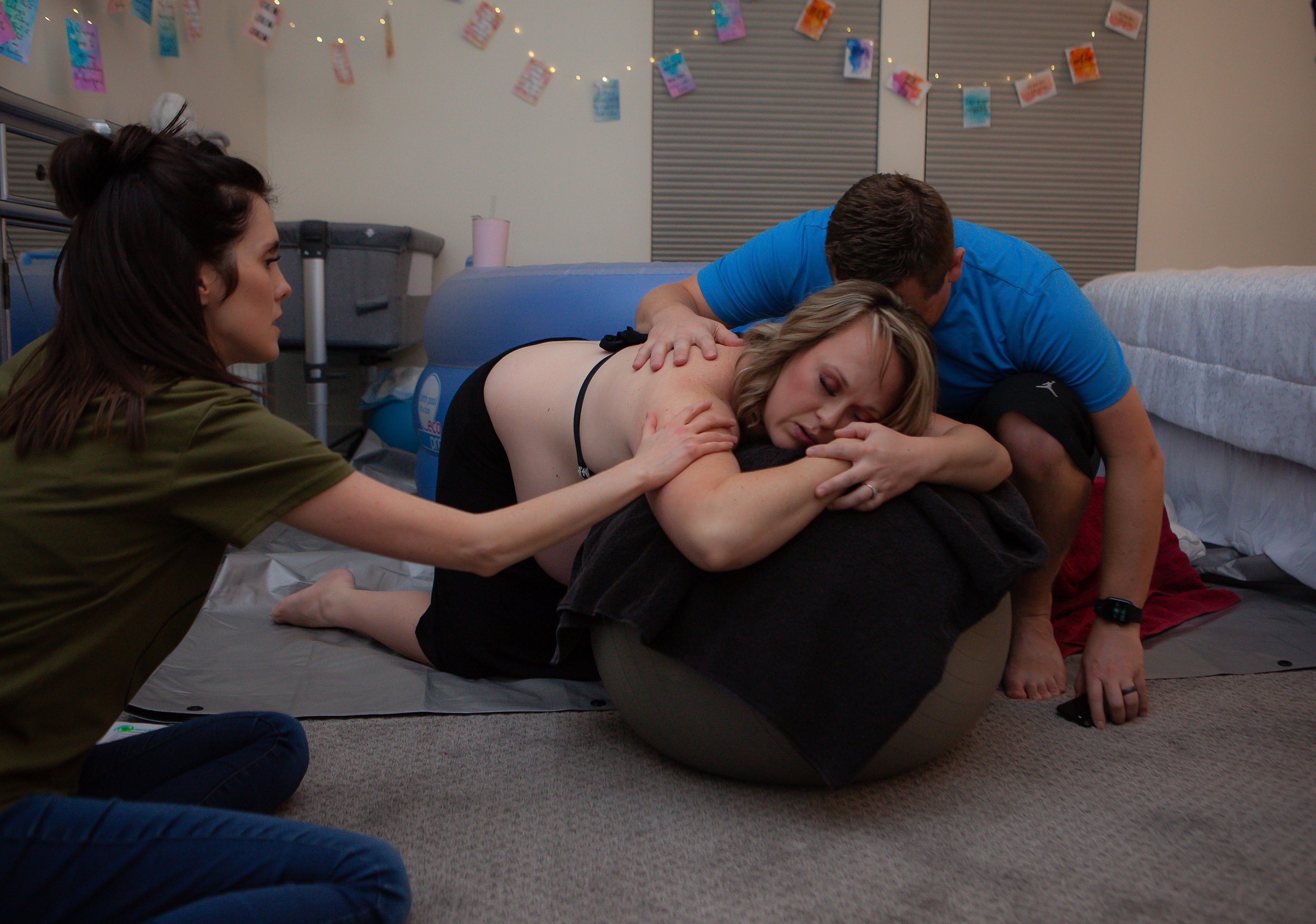
Image credits: Lori Engel Photography

Baby Talk
Talking to our babies is an important skill and habit we can begin in utero. Then as our children grow, we will be learning how to best communicate with them and their unique communication style. This is such a valuable asset in our relationship with our children that will last a lifetime.

I always encourage my clients to communicate with their babies in pregnancy. This can be out loud or if that feels awkward, then silently. Your baby can still hear and understand you as he or she grows in your womb. An example of this might be, “Baby, we love you and are so excited that you are joining our family.”
Both women and their care providers can practice communicating with babies. Several years ago, I attended a birth of a woman whose baby was crowning, but taking a lot of time to come out. Her midwife realizing that the baby was presenting with his hand next to his head, simply said, “Baby, can you move your hand?” The baby immediately moved his hand and was born moments later. This of course is a story with quick, dramatic results, but even still we can ask our babies, “What do you need from me to help you to be born in the safest way?” It takes practice, but we can learn to hear what our babies are communicating back to us.
We might get into the habit of talking to our babies in utero, but let’s continue the habit when they are born. Let me paint a scenario for you. Let’s say you were lying in bed and someone came up to you and lifted your legs up over your head. What would your reaction be? You’d probably be shocked and protest loudly! Isn’t this what we do to babies every time we change their diaper? What would happen if we took a moment to tell our baby that we were going to change his diaper, that it would only take a minute or two and then he would be clean and dry and feel more comfortable. Try it and see how your baby responds.
Here’s another example. How would you feel if someone just put you in the car and started driving? You’d probably loudly protest, wanting to know where you going and when you would get there. Start talking to your baby anytime you are about to do anything to your baby, take your baby anywhere, or leave your baby with a sitter.
Let’s think for a moment about medical procedures. Having a doctor, nurse, or other medical care provider do anything to a baby that might cause discomfort definitely deserves explanation. For example, when I took my daughter to have a blood test at the doctor’s office, I told her, “the doctor is going to poke your heel with a needle and squeeze some blood out. Mommy is going to be right here. It will only take a few minutes and then I’m going to pick you back up and snuggle you close.” Guess what, my daughter did not cry at all during the procedure. I’m not saying that babies won’t ever cry once you start talking to them, things might still cause discomfort and crying is their only way of communicating. However, when we talk to our babies we are communicating to them that they are important and valued and isn’t that what we all desire at our core—to know that we are important and valued, especially by those we love?
Talking to our babies is an important skill and habit we can begin in utero. Then as our children grow, we will be learning how to best communicate with them and their unique communication style. This is such a valuable asset in our relationship with our children that will last a lifetime.
For more information on baby awareness, psychologist Dr. David Chamberlain dedicated much of his life’s work to study and write about babies awareness. You can read more in his books, Windows to the Womb and The Mind of Your Newborn.
Kelly Colvin, HCHI, HCHD

A Joyous Time—The 4th Trimester
The world becomes more beautiful and we live life with greater gratitude and purpose with the arrival of a new baby. Babies also take up a lot of time and it's helpful to anticipate our needs so we can better care for our babies. Here are some tips to make the postpartum period, also known as the "4th trimester" easier and more joyous.
Barbara Katz Rothman said, “Birth is not only about making babies. Birth is about making mothers-strong, competent, capable mothers who trust themselves and know their inner strength.” When women come to their births prepared and educated, they are empowered to make the best decisions for themselves and their babies. Your preparation for birth will help your transition into motherhood to be easier. There are several things you have already done to prepare yourself for this transition. These things can help you feel good about your birth, make recovery easier and faster, and facilitate bonding with your partner and baby.
· Educate yourself in all of your choices for birth, by taking a childbirth class and reading about birth.
· Hire a care-provider who is on board with your birth plan.
· Hire a doula to support you and your partner in the birth you envision.

Your life is about to change in amazing and beautiful ways. Carl Sandburg said, “A baby is God's opinion that the world should go on.” The world becomes more beautiful and we live life with greater gratitude and purpose with the arrival of a new baby. Babies also take up a lot of time and it's helpful to anticipate our needs so we can better care for our babies. Here are some tips to make the postpartum period, also known as the "4th trimester" easier and more joyous.
· Breastfeed your baby.
Breast milk is the perfect food for your baby. It also promotes healing in you and helps you bond with your baby. Learn as much as you can about breastfeeding prenatally, take a breastfeeding class, and continue to learn after your baby is born.
· Consider placentophagia.
Though it may sound unconventional, there is growing research in the field of placentophagia—consuming ones placenta. Many women claim it helps in the postpartum period by assisting your milk supply, aiding your uterus in returning back to pre-pregnant size, reducing a woman's risk of postpartum blues and depression, reducing fatigue, increasing energy, easing the hormonal shift.
· Get support. This can come from your birth partner, family members, and other women.
Support comes in many forms. Emotional—listening ear. Physical—help with chores, baby care, etc. Spiritual—understanding what you may want or need to feel connected to your higher power and finding time for spiritual activities.
· Eating regular nutritious meals and snacks.
When you eat well, you feel well. Stock up on healthy granola bars, yogurt, cheese sticks, and nuts. Buy a pre-cut veggie tray from the grocery store and use it for easy meals and snacks during the week. Fruit is almost always an easy snack—apples, bananas, oranges, grapes, etc. Larger fruits can be cut up by a support person over the weekend and then mom can have quick and easy go-to snacks during the week. Pre-cooked chickens from the grocery store, instant oatmeal packets (without added sugar), and canned soups can be quick, easy, and nutritious options.
· Be okay with the mess.
It can wait—it will still be there next week or even the week after. Your baby needs you now. Take this precious time to enjoy and bond with your baby. If a mom is bothered by the clutter, ask a family member or friend to come help tidy up. Hire a teenager to play with older siblings or help with basic chores. Or consider hiring a postpartum doula. She will be happy to help with household chores such as cleaning, laundry, cooking, and even caring for older children while the new mom catches a nap. If finances are an issue—consider just 3 or 4 hours a week—it can make a huge difference and many find it well worth the cost.

· Get plenty of sleep.
A good rule of thumb to follow is—sleep when your baby sleeps. This means, take a nap no matter what time it is. You will be glad you did. A well rested mom is a much happier mom. You may want to consider safe cosleeping, baby sleeping in the same room as mom and dad, or not. Try different things and figure out what you are comfortable with and what works best for YOUR family.
· Wear your baby.
Your baby has been carried around, by you, for 9 months. Most babies still enjoy being close to their mothers (and fathers) after birth. Some babies refuse anything but being in the arms of their mom or dad and that's okay. They may just need more time adjusting to life outside the womb than others. When you respond to your baby's cries by holding, rocking, and nursing your baby, you are teaching your baby how to communicate and that your baby can trust you. Your loving response teaches your baby that he or she is important and valued. This will help your baby to grow up to become a confident, loveable, independent individual. Listen to your instincts—hold your baby, snuggle your baby, and respond to your baby's cries—and notice that it just feels right. Do this with confidence knowing you are giving your baby a wonderful foundation in life by responding to your baby's needs. A baby cannot be spoiled—only loved.
Baby wearing can reduce crying, improve breastfeeding, bonding and attachment—all which can be helpful in reducing stress as a new parent. It is a wonderful way for partners to participate in the care and bonding. It also frees up the wearer’s hands to do other things such as eat, do simple chores, and care of older children.
· Seek out other women that share similar philosophies in mothering.
Join a mothering group (or start your own) where you feel you get support in your role as a woman and mother and one that encourages you to listen to YOUR motherly instincts.
· Be Good To Yourself.
Some mothers can experience burn out. To prevent this, or if it occurs—to bounce back quickly, it is important to take care of your needs and listen to your instincts. If a mother starts to feel overwhelmed it can be a sign for her to take some time for herself. Get a massage, schedule lunch with friends, take a yoga class, go for a run, take a bubble bath, or a long nap. Do something for yourself that helps you to feel refreshed and rejuvenated and excited about being a woman, partner, and mother.
You are about to embark on a beautiful, exciting journey called motherhood. Where you will grow lots, and love much. As Dr. Seuss would say, "You are off to Great Places! … So be sure when you step, step with care and great tact. And remember that life's a great balancing act. And will you succeed? Yes! You will, indeed!"
Kelly Colvin, HCHI, HCHD
PeacefulBirthChoices.com
Thanks to LindsaySharifiPhotography for sharing her talents.

Transformation - Going Beyond Your Physical Form
Transformation is an amazing time, an exciting time; a time of stretching and allowing not only physically, but also spiritually and emotionally. You are opening yourself up to becoming a mother to this baby. It is a thrilling, exciting, and challenging endeavor. Whenever we are learning, stretching and growing it takes patience and it calls for great strength and courage.

In Hypnobabies we use special words with positive connotations to talk about the different stages of birth. We use the word transformation for the sage of birth when a mom’s cervix is dilating from 7 to 10 centimeters. So much occurs in those three centimeters. A baby begins to move down deeper into the pelvis preparing to come out and enter this world.
Transformation is an amazing time, an exciting time; a time of stretching and allowing not only physically, but also spiritually and emotionally. You are opening yourself up to becoming a mother to this baby. It is a thrilling, exciting, and challenging endeavor. In life whenever we are learning, stretching and growing it takes patience and it calls for great strength and courage. Whenever I am going through a growth experience, I have found that it is easier when I am surrounding myself with supportive, loving people; people that remind me of my goals and remind me of my strength. And so it is with birth, as we go through the transformation process we call on those around us. We ask them for needed support. That may feel like a back rub, that may sound like words of encouragement, that maybe look like a plate of food or a drink of water.
The definition of transformation is, “a dramatic change in form or appearance” or “a metamorphosis during the life cycle.” My favorite definition is, “going beyond your physical form.” That's exactly what you are doing when you give birth. You are going beyond what you are now to become something stronger, wiser, more intuitive. You are in the process of becoming. You are becoming a mother.
Kelly Colvin, HCHI, HCHD
Thank you lindsaysharifiphotography.com for sharing your talent.

Dakota's Home Birth
Dakota’s birth was immensely evolutionary and evocative. I birthed her into this world the way Mother Nature intended. No drugs. No bright lights. No institution. Peacefully. Intimately. Safely.

Dakota’s birth was immensely evolutionary and evocative. I birthed her into this world the way Mother Nature intended. No drugs. No bright lights. No institution. Peacefully. Intimately. Safely. This is my sacred rite of passage. This is my natural birth story.
Please note: I used Hypnobabies hypnobirthing techniques. I’ve been taught to use different vocabulary without negative connotation – “pressure waves” refers to contractions, and “birthing time” refers to labor.
I was 9 days past my “guess date”, so I went to see my midwife Liz at 11am on October 27, 2017 to get my progress checked. I was 3cm dilated, which surprised me because I hadn’t felt any pressure waves, only mild menstrual-like cramping. Knowing that my birthing time was near, I went home and practiced my hypnosis techniques.
At 4:15pm, I awoke from a deep hypnosis. As I got out of bed, fluids came rushing out. I wasn’t sure if I had peed all over myself, or if my water broke! I went to the bathroom and checked to see what happened down there – it was definitely the latter. I immediately called my Liz and told her what happened.
Click HERE to read the rest of Stephanie's beautifully written birth story and follow her for delicious, healthy recipes, and holistic living tips.

Creative Ways to Pay for Non Conventional Birth Care
There are many non conventional options regarding pregnancy, birth and postpartum care. These often are not related to physician or hospital care. These options may or may not be covered by your insurance. Things such as prenatal and postpartum massage, chiropractic care, birth doula support, placenta encapsulation, acupuncturist care the list can go on. The first step in determining what care you would like to receive would be to research the many options.
We'd like to thank Stacey Davis of Your Birth Time for sharing this blog post with us. Stacey is a doula, placenta encapsulation specialist, and postpartum wellness coach.

There are many non conventional options regarding pregnancy, birth and postpartum care. These often are not related to physician or hospital care. These options may or may not be covered by your insurance. Things such as prenatal and postpartum massage, chiropractic care, birth doula support, placenta encapsulation, acupuncturist care the list can go on. The first step in determining what care you would like to receive would be to research the many options. Using research and your own self history can help you decide what non conventional care you would like during your pregnancy, birth and postpartum. Once you have decided what you want to implement in the care you receive then decide how you are going to pay for it. Here are five creative ways to pay for those services:
1. Skip that treat, pocket the change. We all have that one treat we allow ourselves which may not be the best for our baby while we are pregnant or even breastfeeding. You know that Starbucks indulgence or bag of kisses stuffed in your top drawer. Skipping your daily Starbucks for one month could save you about $100!
2. Barter or trade for partial services. Many non conventional birth workers will barter or trade for part of the services they offer. Do you have a special talent or does your husband, mom, dad or brother run a local business that would benefit your birth worker? Work out a trade. You could even offer to babysit or prepare meals for your birth worker when they are called to a birth or to assist a pregnant or postpartum mom.
3. Create a registry for your birth services. Twenty dollars from ten of your close friends or family members comes up to $200. This could definitely help you pay for the birth services that you would like. Let’s face it, several of these family and friends would contribute much more than $20! Call your birth worker and ask them to work with you to come up with a registry for their services.
4. Birthday, Christmas or baby gifts ask for cash in place of gifts. Gift cards are also another great option. Many birth workers are willing to work with you to create gift cards or gift certificates. I know that asking friends and family for money instead of gifts can be a little uncomfortable. When you explain what it is for they will understand and be more than willing to accommodate.
5. Check with your insurance, cafeteria plan or HSA. Yes many moms have gotten their insurance, cafeteria or HSA to cover these services, even doula care and some portion of home birth services. Talk with your local birth provider she will be the most familiar with how to arrange this for your area.

Tips For An Easier Pregnancy and Birth
Whether a woman is expecting her first or ninth baby, pregnancy and birth are important events in her life. Women who take time to prepare prenatally can have easier, more comfortable pregnancies and births. Here is a list of things that can help you as you prepare to give birth.
Hire a care provider
Many women today are looking for more natural birthing options, like un-medicated birth, water birth, delayed cord clamping, and immediate skin-to-skin with baby after the birth. Read some books on childbirth to find out what is important to you and then talk to your care provider and ask how he or she plans to support you in achieving the birth you desire. Remember, your doctor or midwife works for you, and it is in your best interest to hire one that is supportive of your desires.
Whether a woman is expecting her first or ninth baby, pregnancy and birth are important events in her life. Women who take time to prepare prenatally can have easier, more comfortable pregnancies and births. Here is a list of things that can help you as you prepare to give birth.
Hire a care provider

Many women today are looking for more natural birthing options, like un-medicated birth, water birth, delayed cord clamping, and immediate skin-to-skin with baby after the birth. Read some books on childbirth to find out what is important to you and then talk to your care provider and ask how he or she plans to support you in achieving the birth you desire. Remember, your doctor or midwife works for you, and it is in your best interest to hire one that is supportive of your desires.
Take a childbirth class
There are several different childbirth classes available today. Look for one that teaches the physiology of birth, how to stay healthy and low risk, the benefits, risks and alternatives for common medical procedures, and relaxation techniques. Every woman, whether planning a natural or medicated birth, needs to understand how her body will be working in labor and what options she has when giving birth. It is very empowering for a woman to go into her birthing time armed with the knowledge and the tools to help her give birth.
Hire a doula
A doula is a non-medical labor support person who is trained to help women throughout birth by providing information, as well as physical and emotional support. Statistically, women who have the support of a trained doula have shorter labors, fewer complications, decreased medication use, fewer cesarean sections, and increased overall birth satisfaction. A doula can be a great asset to all women in a variety of birthing situations and can help them achieve their goals for the birth they desire.
Schedule time to relax daily
Women who take time to relax daily have easier and more enjoyable pregnancies and labors. In labor, a woman’s birthing muscles function better when she is relaxed. Sign up for some yoga classes, practice meditation or hypnosis, or listen to classical music — do whatever makes you feel physically and mentally relaxed — and do it every day.
Eat well
Pregnancy provides a great opportunity to begin eating healthy, if you aren’t already doing so. Your diet will impact your health and your baby’s health. Replace processed foods and soda with whole foods and water. Read food labels and eat lots of fruits, vegetables and high-quality protein. When you eat well, you feel well.
Receive regular chiropractic care
Women who are regularly adjusted by a chiropractor throughout their pregnancies have much more comfortable pregnancies and labors. As a woman’s belly is expanding and growing, it can shift the spine out of alignment. Regular adjustments not only help ease pregnancy discomforts but also help your baby get into the best position for birth — head down, chin tucked, facing toward your back. When your baby is in the optimal fetal position, you will have an easier labor, and you will have more options as you give birth.
You will remember your child’s birth for the rest of your life, so make sure it is a good memory. Your educated choices can empower you as a woman and mother like no other event in life. Birth is unpredictable and full of surprises, so maintain flexibility as you plan for and expect the very best.
Kelly Colvin, HCHI, HCHD
*Originally published by The Spectrum Daily News on December 17, 2014

Elizabeth's Story
Growing up I had always planned on getting an epidural during labor, but I found myself reevaluating that decision when I was actually pregnant for the first time. I did a lot of reading and talked to several friends who had experienced an unmedicated birth. This appealed to me and I decided I would also try to have a natural childbirth.
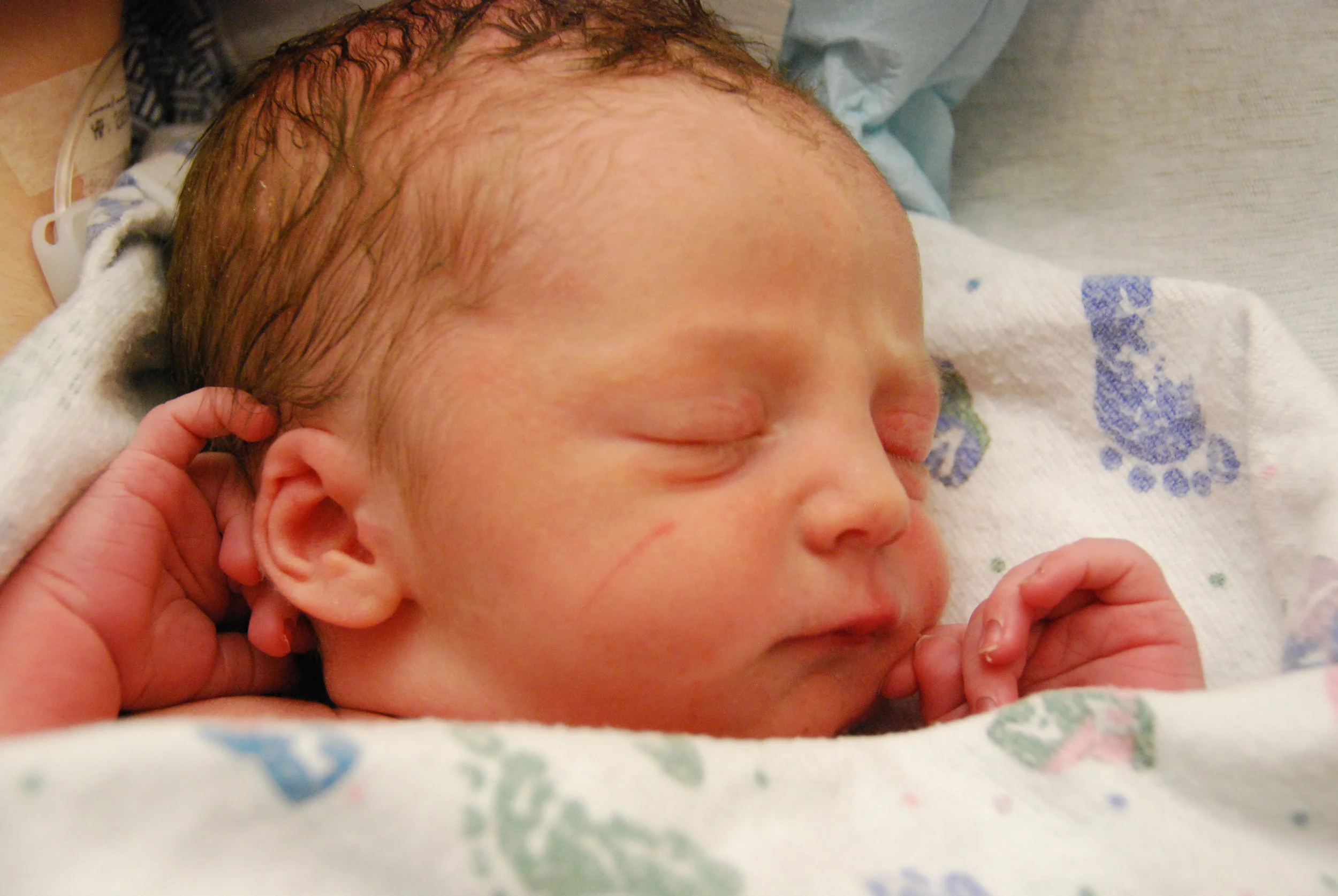
Growing up I had always planned on getting an epidural during labor, but I found myself reevaluating that decision when I was actually pregnant for the first time. I did a lot of reading and talked to several friends who had experienced an unmedicated birth. This appealed to me and I decided I would also try to have a natural childbirth.
My husband was also supportive of this. We felt strongly that we would need extra support to help get us through labor. A family member had suggested we hire a doula. Luckily we listened to this advice and found ourselves meeting with Karen (Editor’s note: Karen was a previous doula at Peaceful Birth Choices and is now taking a break from birth work) a couple months before I was due.
Karen was very helpful even before I went into labor. She came to our home to meet us and to get an idea for our birth preferences and to answer questions. She also helped us become familiar with our birthing options and gave me suggestions on topics to discuss with my doctor before the big day. Most importantly, she helped me feel calm about labor. I knew she was a good fit for us.
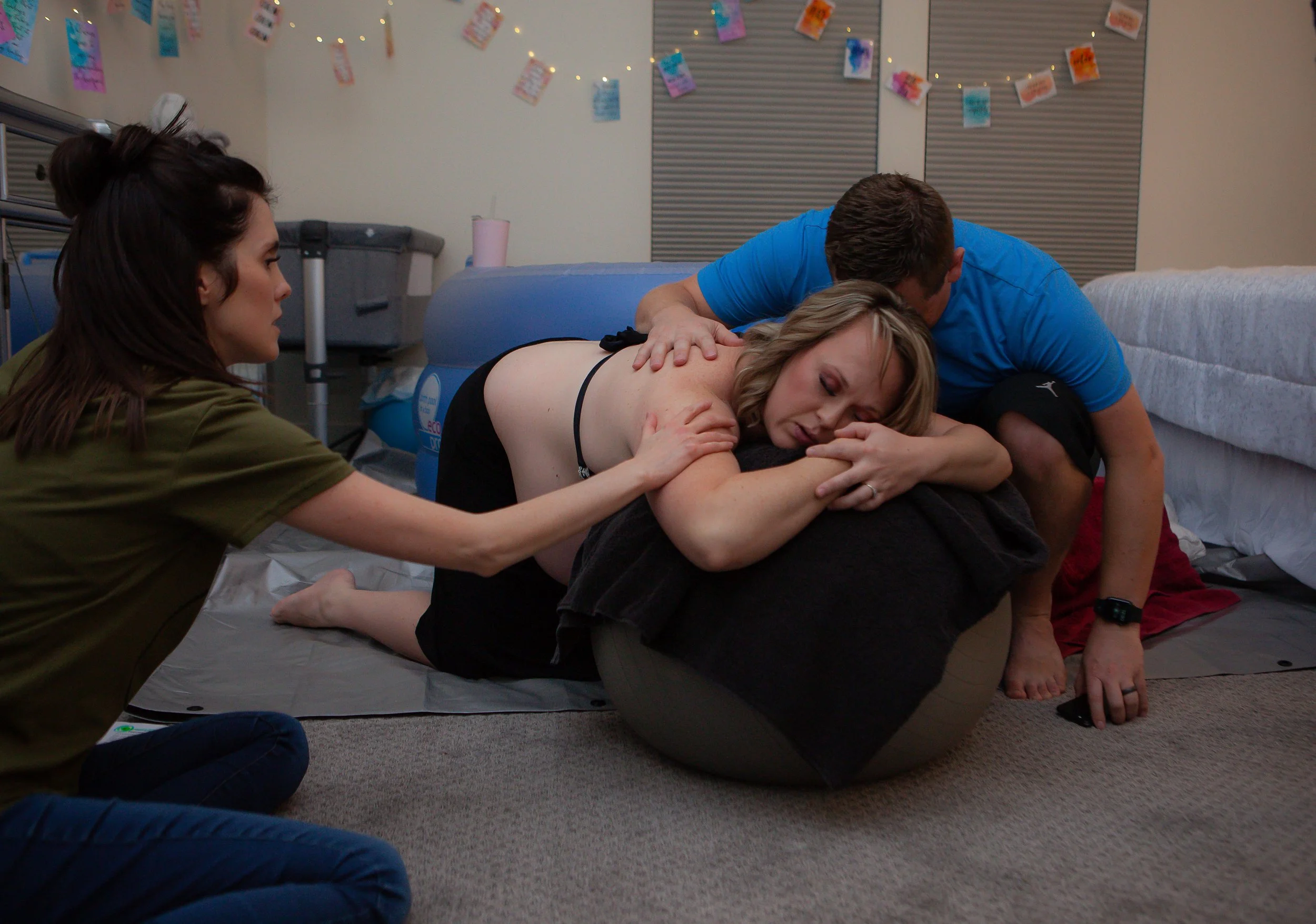
We called Karen at 2 AM, two days before my due date, to tell her that my water had broken and that we were on our way to the hospital. She was there shortly after we arrived. She immediately was helping me feel comfortable by getting me drinks, offering suggestions to help my labor progress, and by providing many words of encouragement. My labor progressed very slowly at first and my doctor wanted to start Pitocin. This was one of my big concerns with labor and was something I absolutely did not want to do. With Karen’s help we had learned the importance of asking for more time before starting interventions. We also were aware of natural ways to help labor progress. We were fortunate that my labor did pick up on its own and Pitocin was not necessary. Karen and my husband were very involved during my labor by helping to manipulate my body into more comfortable positions during contractions. Karen was great at suggesting new positions for me to try. She was also able to guide my husband and help him know how to best help me. Karen was able to discern when I needed help, when my husband needed support, and when we needed privacy as a couple.
The birth of my son was such a beautiful experience for me and my husband. We will always feel a close connection with Karen since she was part of such an intimate moment in our lives. Since my experience with Karen was so positive I plan on doing natural childbirths with my future children, of course with the help of a doula! on getting an epidural during labor, but I found myself reevaluating that decision when I was actually pregnant for the first time. I did a lot of reading and talked to several friends who had experienced an unmedicated birth. This appealed to me and I decided I would also try to have a natural childbirth.
My husband was also supportive of this. We felt strongly that we would need extra support to help get us through labor. A family member had suggested we hire a doula. Luckily we listened to this advice and found ourselves meeting with Karen a couple months before I was due.
Karen was very helpful even before I went into labor. She came to our home to meet us and to get an idea for our birth preferences and to answer questions. She also helped us become familiar with our birthing options and gave me suggestions on topics to discuss with my doctor before the big day. Most importantly, she helped me feel calm about labor. I knew she was a good fit for us.
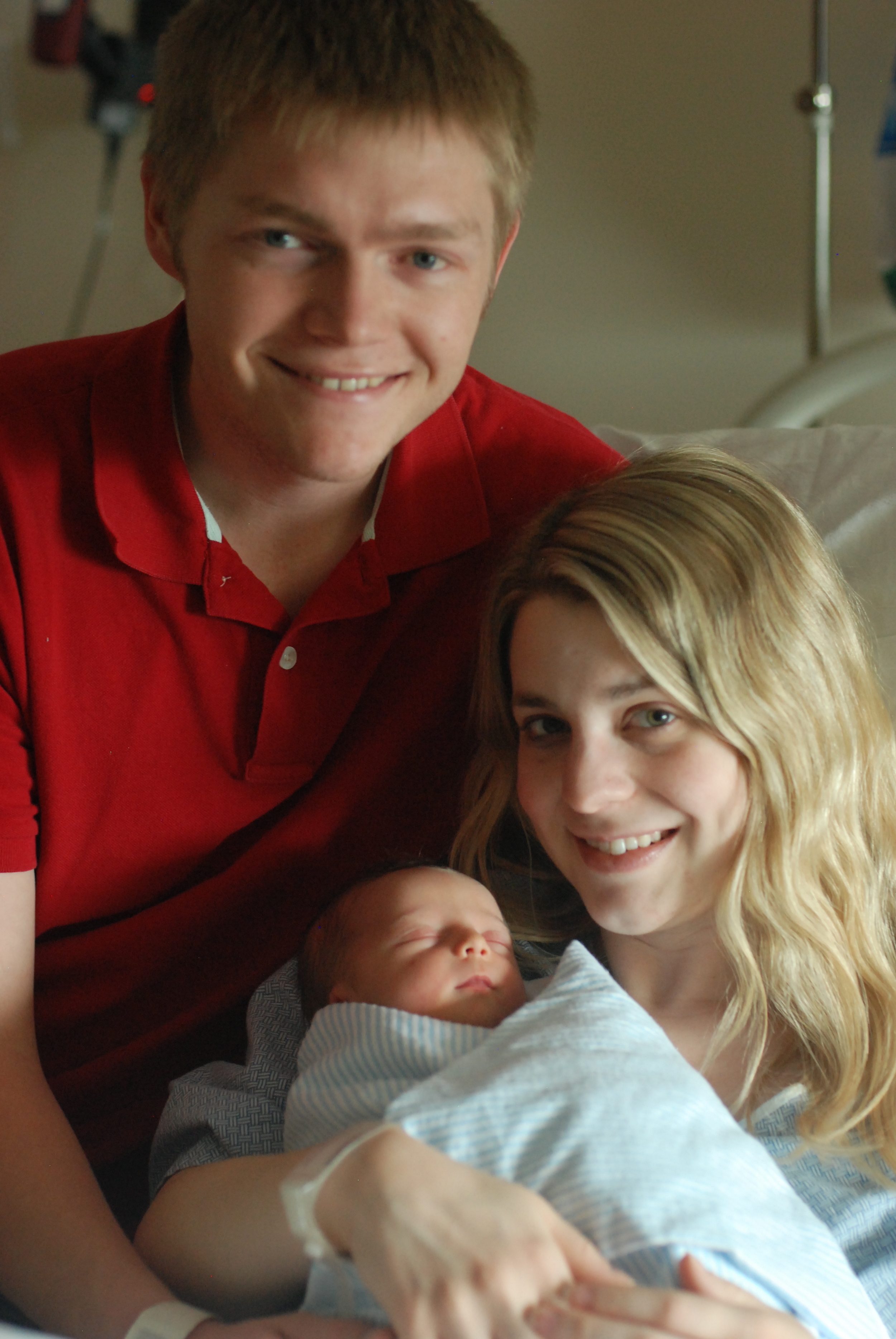
Woman delivers her baby un-medicated in the hospital with the support of a doula.
We called Karen at 2 AM, two days before my due date, to tell her that my water had broken and that we were on our way to the hospital. She was there shortly after we arrived. She immediately was helping me feel comfortable by getting me drinks, offering suggestions to help my labor progress, and by providing many words of encouragement. My labor progressed very slowly at first and my doctor wanted to start Pitocin. This was one of my big concerns with labor and was something I absolutely did not want to do. With Karen’s help we had learned the importance of asking for more time before starting interventions. We also were aware of natural ways to help labor progress. We were fortunate that my labor did pick up on its own and Pitocin was not necessary. Karen and my husband were very involved during my labor by helping to manipulate my body into more comfortable positions during contractions. Karen was great at suggesting new positions for me to try. She was also able to guide my husband and help him know how to best help me. Karen was able to discern when I needed help, when my husband needed support, and when we needed privacy as a couple.
The birth of my son was such a beautiful experience for me and my husband. We will always feel a close connection with Karen since she was part of such an intimate moment in our lives. Since my experience with Karen was so positive I plan on doing natural childbirths with my future children, of course with the help of a doula!